


📅 Last Updated: June 25, 2026
Imagine this: You’ve just sold a high-end 100kW silent diesel generator to a hospital or a luxury resort. You promised your client—someone as assertive and no-nonsense as my buddy Mark Shenng in Canada—that this machine would be “whisper quiet.” You ship it, they turn it on, and suddenly the neighbors are calling the police because it sounds like a jet engine having a mid-life crisis. The “premium” brand Mark is building in Canada starts to crumble because the supplier cut corners on the acoustic canopy.
A “silent” generator is built using a heavy-duty cold-rolled steel enclosure lined with high-density, fire-resistant acoustic mineral wool. The design features a complex “labyrinth” baffle system for air intake and exhaust, which forces sound waves to bounce and dissipate while allowing the engine to breathe. Combined with residential-grade mufflers and anti-vibration mounts, these elements reduce the noise of a 100kW Cummins engine from over 100 decibels to a professional 65-75 dB(A) at 7 meters.
Don’t let a cheap metal box ruin your reputation. I’m Alex Zhang, CEO of GoCommins, and I’m going to take you deep inside our 5 production lines to show you how real silence is engineered.
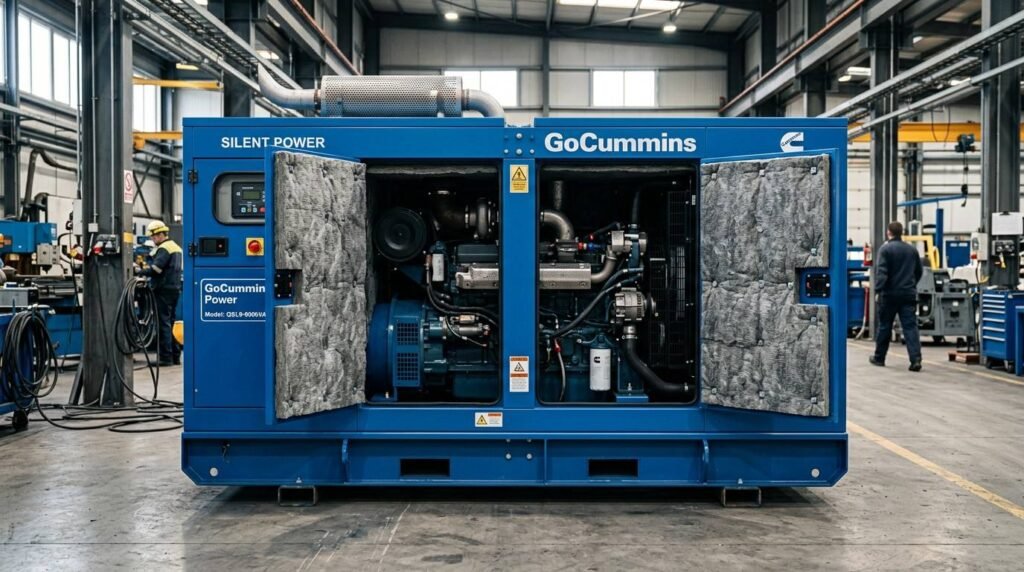
Is the Outer Shell Just a Metal Box or a Suit of Armor?
When Mark Shenng looks for suppliers, he’s sensitive to quality because he rebrands our units at a premium. He knows that the outer shell is the first line of defense. At GoCommins, we don’t just use any scrap metal. We use 2mm to 4mm high-strength cold-rolled steel for our canopies. This isn’t just about durability; it’s about mass. Heavy steel vibrates less than thin, flimsy sheets. If the box itself is rattling, you’ve already lost the battle against noise.
We also treat this armor with a rigorous multi-stage powder coating process. Why? Because a “silent” generator that rusts out in three years in the Canadian humidity isn’t silent anymore—it’s a vibrating pile of junk. Our enclosures are built to withstand ISO 9227 salt spray testing, ensuring the canopy remains airtight and sound-tight for decades. In the B2B world, longevity is the only way to avoid those annoying “inefficient communication” complaints from angry distributors.
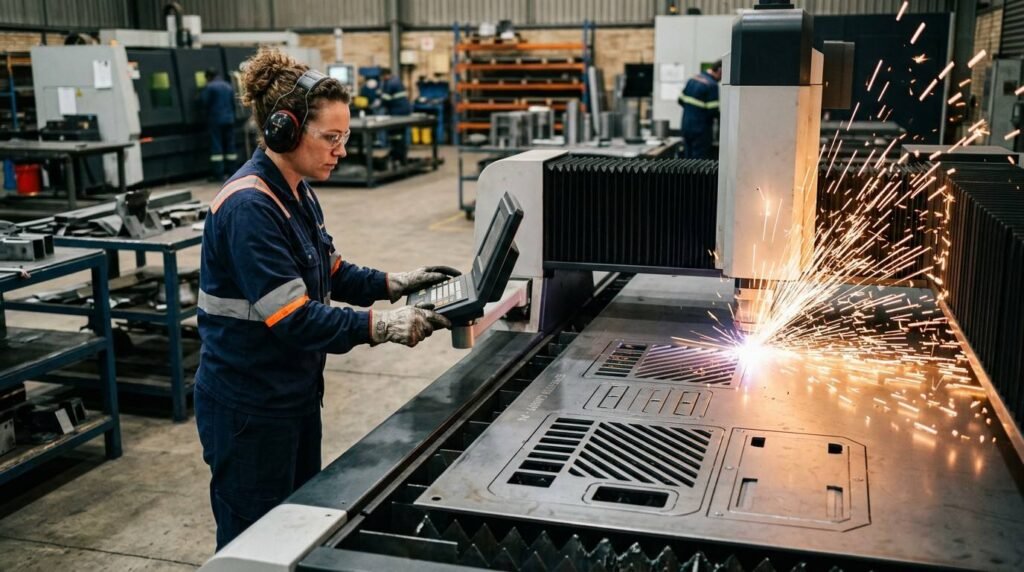
What is the “Secret Sauce” Inside the Walls of the Canopy?
If the steel is the skin, the acoustic foam is the muscle. I see a lot of “certificate forgery” in this industry where suppliers claim to use high-density foam but actually use cheap, flammable sponge. At GoCommins, we use fire-resistant mineral wool or high-density acoustic cotton. This material is designed with a porous structure that traps sound waves and converts their energy into tiny amounts of heat. It’s the difference between shouting in a library and shouting in a bathroom.
We don’t just glue it on and hope for the best. We use a perforated galvanized sheet to hold the insulation in place. This protects the foam from oil mist and mechanical wear while allowing sound waves to enter the material. For a 100kW unit, we use a thickness of at least 40mm to 50mm. If your supplier is using anything thinner, they aren’t selling you a silent generator; they’re selling you a very expensive speaker box for engine noise.

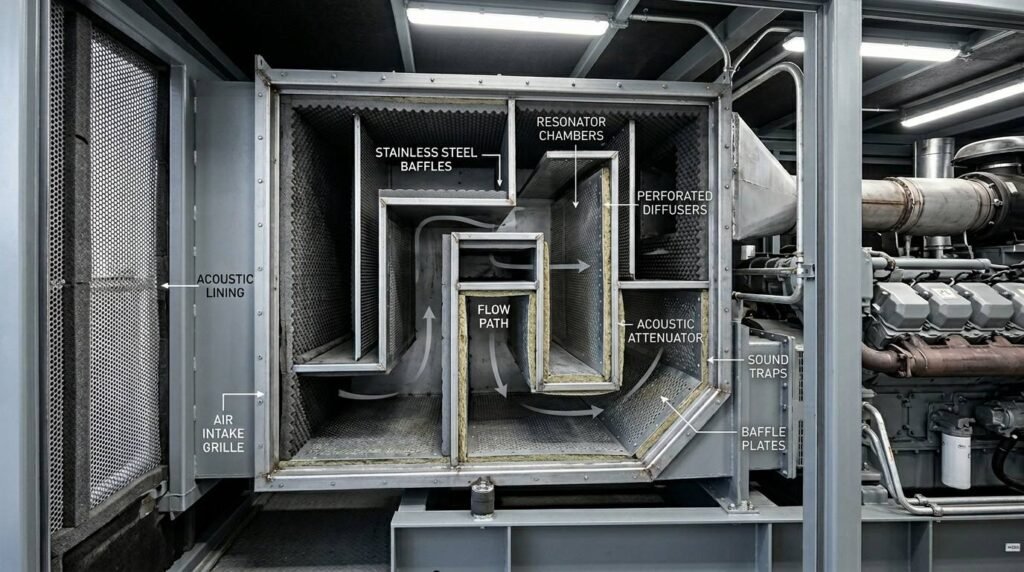
How Does a Generator Breathe Without Letting the Noise Escape?
This is the part where most technical novices get confused. Engines need massive amounts of air for cooling and combustion. If you seal the box completely, the engine will melt. If you leave big holes, the noise will scream out. The solution is the “Labyrinth Baffle.” Think of it as a maze for air. We design internal air ducts that force the sound waves to make multiple 90-degree or 180-degree turns.
Air is flexible, so it flows through the maze. Sound waves are stubborn; every time they hit a wall in our maze, they lose energy. At our factory, we use CFD (Computational Fluid Dynamics) to ensure the air pressure drop isn’t too high. If the engine chokes, you get “delayed shipments” because the unit failed its load test. We balance thermal efficiency with acoustic suppression, which is why Mark’s rebranded units can run in the middle of a Toronto summer without breaking a sweat.
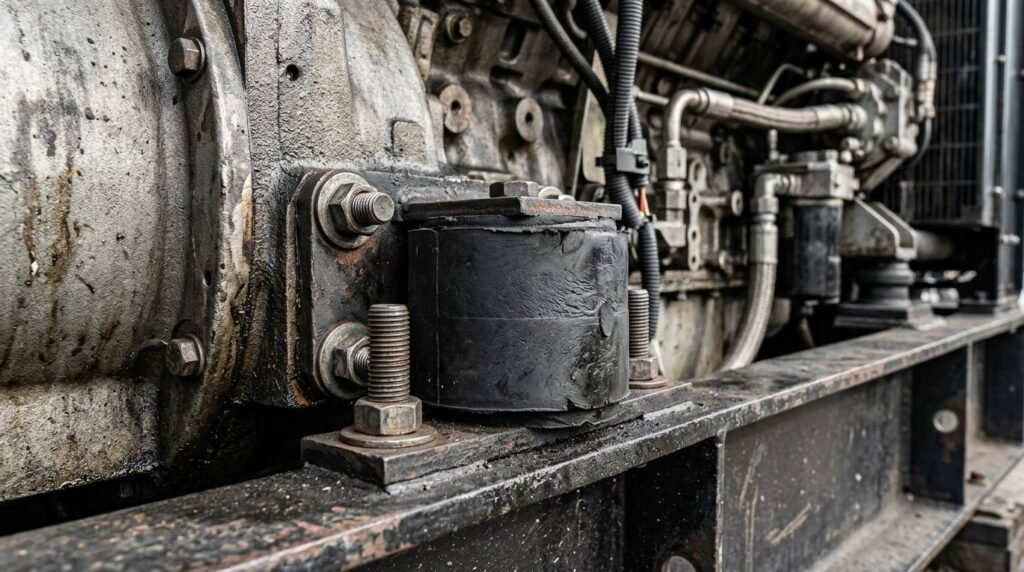
Why are Anti-Vibration Mounts the Unsung Heroes of Silence?
Noise isn’t just air-borne; it’s structure-borne. A Cummins engine is a powerful beast, and it wants to dance. If you bolt that engine directly to the steel canopy, the entire box becomes a giant tuning fork. We use high-performance rubber isolators between the engine-alternator assembly and the base frame. These mounts absorb the kinetic energy, keeping the vibration from reaching the outer shell.
I tell Mark all the time: “You can’t have silence without stability.” We even use flexible bellows for the exhaust connection to ensure the vibration doesn’t travel through the muffler. If your supplier skips these flex-joints, the exhaust pipe will eventually crack, leading to a massive leak and a very loud, very expensive repair bill. At GoCommins, we customize these mounts based on the specific weight and RPM of the Cummins engine model to hit that perfect “hum.”
The Muffler: Is Yours Industrial Grade or Residential Grade?
The exhaust is the loudest part of any diesel engine. A standard industrial muffler is like a megaphone for diesel combustion. To make a generator truly silent, you need a “Residential Grade” or “Critical Grade” silencer. These are significantly larger and contain multiple internal chambers to dampen the “bang” of every piston stroke. According to EPA Noise Control standards, these mufflers can reduce exhaust noise by 25 to 35 decibels.
At GoCommins, we mount these silencers inside the canopy to keep the profile sleek, but it’s a tight fit. It requires five production lines of specialized workers to get the plumbing exactly right. If the muffler is too small, the backpressure increases, which hurts fuel efficiency and engine life. I know Mark likes competitive pricing, but he loves his profit model more—and he knows that a quiet, efficient machine is the only thing his customers will pay a premium for.
Quality Inspection: How Do We Prove the Silence?
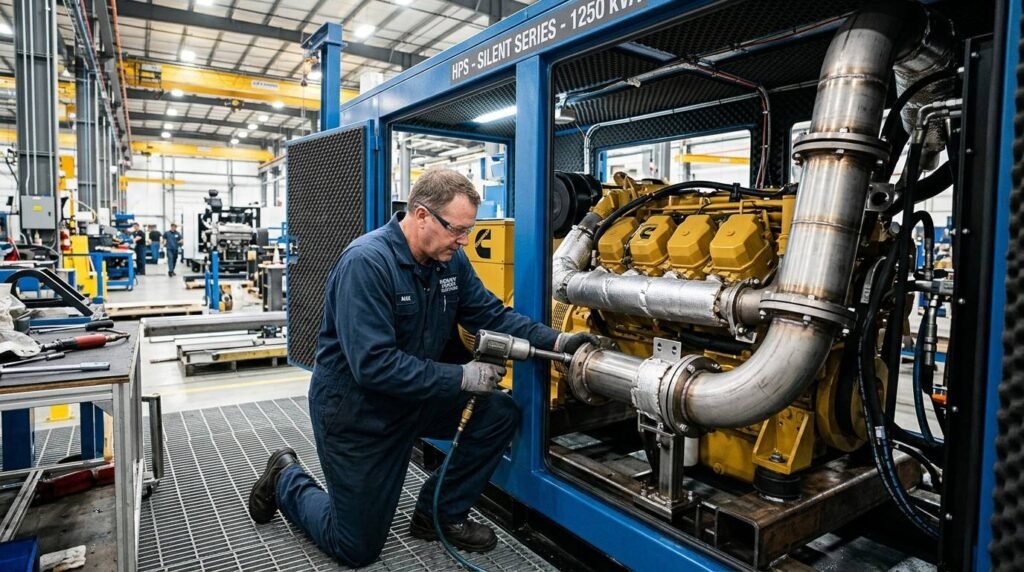
In my factory, talk is cheap. We prove our quality with data. After every silent generator is assembled, it goes into our testing bay. We use calibrated sound level meters to measure the noise from four different angles. We check the decibels at full 100kW load. If it’s one decibel over our limit, it goes back to the production line. We don’t do “forgery”; we do verification.
Many buyers lack technical expertise, so we provide them with a full Factory Acceptance Test (FAT) report. When Mark shows this report to his clients in Canada, he looks like the expert he is. He’s not just a middleman; he’s a distributor of verifiable power. This transparency is what eliminates the pain point of “inefficient communication.” The data speaks for itself, so we can spend our time talking about the next big order instead of troubleshooting noise leaks.
Conclusion
Building a silent generator isn’t about slapping a box on an engine. It’s a symphony of steel, foam, and physics. When you choose a GoCommins canopy, you’re buying decades of engineering expertise. Let’s keep your business quiet and your profits loud!

FAQ: How Silent Generator Technology Works
Q: What actually makes a generator “silent”?
A: A silent generator uses a heavy-duty cold-rolled steel enclosure lined with high-density, fire-resistant acoustic mineral wool, plus a labyrinth baffle system for intake and exhaust that forces sound waves to bounce and dissipate while letting the engine breathe. Combined with residential-grade mufflers and anti-vibration mounts, a 100kW Cummins engine drops from over 100 dB to a professional 65–75 dB(A) at 7 meters. GoCommins engineers this acoustic package on every silent unit.
Q: Why do some “silent” generators still sound like a jet engine?
A: Because the supplier cut corners: thin single-wall canopies, no baffle design, cheap mufflers, and no vibration isolation. Sound escapes through every gap and resonates through the frame. At GoCommins, the canopy is treated as a precision acoustic system — cold-rolled steel, mineral wool absorption, and labyrinth airflow are standard on all five production lines.
Q: What noise level should a silent diesel generator deliver?
A: A properly engineered silent genset delivers 65–75 dB(A) at 7 meters for units around 100kW — comparable to a normal conversation and compliant with most urban noise ordinances. GoCommins factory-tests sound levels so the dB rating on your quotation is the dB rating you receive.
Q: Can a silent canopy cause the engine to overheat?
A: Only if the acoustic design blocks airflow. A correct labyrinth baffle system reduces noise while maintaining proper air intake and exhaust flow, so the engine breathes and cools normally. GoCommins validates cooling and airflow in factory tests, so silence never comes at the cost of reliability.
Q: How does GoCommins ensure consistent sound quality across a fleet order?
A: Every GoCommins silent genset is built to the same engineered enclosure specification on dedicated production lines, with standardized acoustic materials, mufflers, and anti-vibration mounts — then verified with factory testing. Distributors get uniform dB performance unit after unit, protecting their brand reputation.